

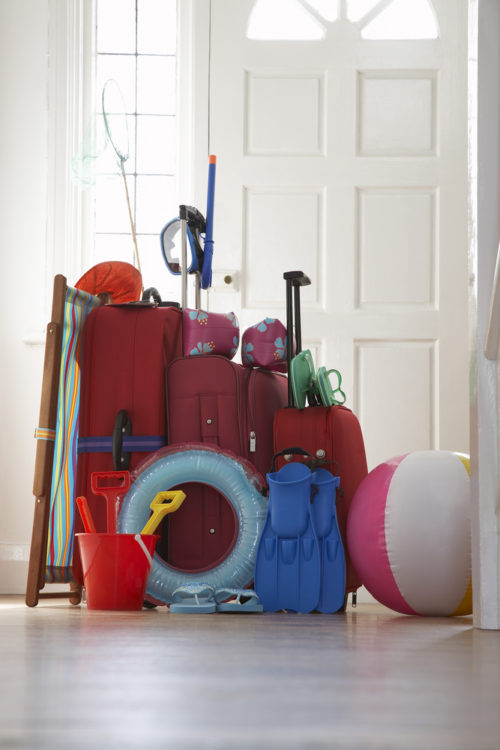
Packing for a family cruise can feel like solving a puzzle, and there’s a good reason for that. You’re not packing for one trip. You’re packing for pool days, dinners that ask for something nicer, port excursions, lazy sea days, and the occasional cold night, all for several people, all stuffed into one small cabin.
Here’s the deal: you do not need a giant itemized list with a separate line for every person. What you actually need is a repeatable system, plus a short list of cruise-specific items people tend to forget. That’s what this guide gives you.
I’ve sailed more than 50 cruises with kids at every age and stage, from babies in diapers through teenagers who roam the ship on their own. Most of those have been warm-weather sailings in the Caribbean, the Mediterranean, and beyond. Over the years our packing has settled into something predictable, and that’s the goal here too. Whether you’re planning a 7-night Caribbean cruise or a 14-night itinerary, this approach will get you ready without dragging along three suitcases you didn’t need.
We’ve also turned the granular tick-box version of all this into a free printable. You’ll find the Family Cruise Prep and Pack Checklist below, so use this article to understand the why and grab the checklist to actually pack from.
If you’re sailing somewhere cold, the basics here still apply, but layering changes everything. Check out our guide on what to pack for an Alaska cruise for that.
The 3 Rules That Stop You From Overpacking
Before any list, start with these three rules. Everything else in this guide hangs off of them.
Rule 1: Space is your real constraint
Most people pack as if weight is the problem. On a cruise ship, the bigger problem is space, specifically storage space in your cabin. A standard non-suite stateroom often runs somewhere between about 150 and 200 square feet, with closet and drawer space sized for roughly 2 adults. (Contrast that with a typical U.S. hotel room at 300 to 400 square feet.)
So be mindful not just of how much you bring, but of how many bags you bring and whether they’ll actually fit once you’re on board. A few things that help:
- Choose luggage you can “nest,” so smaller bags or soft duffels tuck inside larger ones.
- Aim for bags that slide under the bed, where they’re out of the way and not eating your limited closet space.
- Soft-sided luggage is easier to flatten and store than hard cases.
For more on choosing the right bags, see our guide to the best cruise luggage.

Rule 2: Plan your laundry before you pack
This is the single biggest lever for a bigger family. If you plan to do laundry mid-cruise, you can pack far fewer clothes and cut your suitcase count, sometimes close to in half.
Most ships give you options. Many have self-service launderettes with washers, dryers, and even irons. Most also offer valet laundry and pressing through your cabin attendant. And worth keeping in mind: several cruise lines sell discounted laundry packages you can buy online before you sail, often a flat rate for a stuffed bag. Check your options before you leave, because the pre-purchase price is usually the best deal you’ll see.
For the full breakdown, see our post on doing laundry on a cruise ship.
Rule 3: Pack by category, then by person
Here’s how I keep it organized: sort by category first, then by person within each category. Use packing cubes, large zip-top bags, or a mix of both.
A purely person-by-person approach doesn’t quite match real life. For instance, I pack all of the family’s swimsuits and beach items together, and I pack the kids’ dressy outfits together as a group. That way, when it’s time for a beach day or a dressier dinner, I’m pulling from one place instead of digging through four separate piles. Categories keep related items together. The per-person layer makes sure nobody gets shorted.
Before you pack anything, jot down what each family member actually needs based on the cruise: how many dressy nights, how often you’ll change for dinner, and what gear you’ll want that the ship won’t provide.
Quick win: leave behind what the ship already gives you
Some things you simply don’t need to pack, because they’re waiting in your cabin:
- Bath and pool towels. Ships provide bath towels in the cabin and beach or pool towels you can check out for the day. Important note: most lines scan towels to your room card, and an unreturned towel typically runs about $25 to $30 depending on the line (Royal Caribbean is $25, Carnival is $24.95, and MSC runs around $30). It adds up fast for a family, so keep track of them.
- A hair dryer. Your cabin will have one. It may be weak, so if you do serious styling you might bring your own, but most families can leave it home.
- Basic toiletries. You’ll usually find hand soap and some version of shampoo and body wash. The quality is rarely what you’re used to (suites and concierge cabins get nicer products and more of them), so bring your own favorites, but you won’t be starting from nothing.

Clothing: How Much to Actually Bring
Plan to use more clothes than you would at home. You’ll likely change more than once a day, at least on some days, because the ship offers such a range of activities with different clothing needs. Even if you spend the whole day at the pool, you’ll probably rinse off the chlorine or salt and change for dinner.
Everyone has their own style and their own preferences for dressing their kids, so a rigid itemized list isn’t helpful here. One size truly does not fit all. Instead, here are rules of thumb to plan around. (These assume a 7-night cruise. Scale up or down for your length.)
Casual day outfits
Plan one casual outfit per person per day: shorts, t-shirts, tank tops, sundresses, and the like. Adjust down if you’re doing laundry mid-cruise.
And don’t over-count. Plenty of items can be worn more than once, particularly bottoms. A pair of shorts, pants, or jeans can easily go two or three wears. Tops and underwear get swapped daily. Bottoms rarely need to. That one adjustment alone can shrink a suitcase.
If you plan to work out, add exercise clothes. Most ships have a track for walking or jogging and a well-equipped fitness center, sometimes with classes (occasionally for an extra fee).
Evening outfits
Plan an evening outfit for each night too, though many can do double duty with your daytime pieces.
The dress code reality has relaxed a lot. Most lines now keep things flexible, but the main dining room still has a basic expectation: dress a step up from the pool deck. How strictly that’s enforced varies widely, and it also depends on the venue and the timing. At the buffet, wear pretty much whatever you want. At specialty restaurants, people tend to dress up more. And across the board, the earlier you dine, the more relaxed things feel. Generally, the younger the child, the lower the expectations.
For non-formal evenings, think collared shirts and long pants, skirts, dresses, blouses, or dressy tank tops. For kids, respectable shorts or jeans are usually fine.
Formal or “dress your best” nights
You can check in advance how many dressier nights your sailing has, but a good assumption is 2 on a 7-night cruise. The names have changed depending on the line. Royal Caribbean now calls these “Dress Your Best” nights, and Carnival calls them “Cruise Elegant.” Norwegian runs its Freestyle approach with stricter expectations at certain upscale specialty restaurants. Whatever the label, participation is optional, and enforcement tends to be light.
If you’d rather skip it, just dine somewhere it isn’t observed, like the buffet, the pool grill, or room service. That said, do consider doing at least one. It’s more fun than it sounds, and it’s a great chance for nice family photos. (Photographers set up around the ship and walk through the dining room, with no obligation to buy.)
If you’re dressing up, pack the following per person:
- Suit or better for men and boys, and don’t forget the dress shirts
- Cocktail-style dress or better for women and girls
- Ties for men and boys
- Evening accessories like jewelry or a small purse
- Specialty underwear, if needed
- Trouser socks or hosiery, as needed
Some lines also rent formalwear, but you’d need to arrange that in advance. For a deeper look, see our guide on what to wear on a cruise formal night.
Pajamas, underwear, and accessories
For pajamas, however many you go through in a typical week at home is about right. Bring extra for kids in diapers or who are still accident-prone.
For underwear, pack the usual per person plus a few extra to cover wardrobe changes.
For accessories, bring whatever fits your style: scarves, a handbag, casual jewelry. And pack a lightweight jacket or poncho for each person to tuck away for rainy days or cool nights.
One thing first-timers don’t expect: many ships keep the air conditioning in public areas cranked very low. Theaters and dining rooms can be downright chilly. Toss a hoodie or light sweatshirt in the suitcase for everyone. It’s a small thing that saves you from buying a very overpriced one on board.
Shoes Without Overpacking
If your days include any variety, you’ll need more than one pair of shoes per person. The full set of categories looks like this:
- Comfortable walking shoes
- Closed-toe shoes (some excursions require them)
- Beach and pool shoes (flip flops, water sandals)
- Dressy or casual shoes for non-formal nights
- Formal-night shoes
- Gym or track shoes, if you’ll use them
That list looks long, but you don’t need every category for every person. Here’s the real-world shortcut I use for each kid: one pair of all-purpose “active” sandals that work all day and into the evening, one pair of water sandals or shoes, and one pair of dress shoes. Three pairs, covering everything.
A semi-closed-toe hybrid water sandal is the workhorse here. Kids hate switching shoes constantly, so a sandal they can wear all day, kick off in the sand, and wear straight back to the ship solves a lot of friction. For more on those, see our picks for the best water shoes for kids.
Pool and Beach Gear
On a warm-weather cruise, you’ll spend real time at the pool and the beach, so don’t forget the water-day essentials.
- Swimsuits. I recommend 3 per person: 1 wet, 1 drying, and 1 spare for the days you hit both the pool and the beach and don’t want to climb back into a wet suit.
- Swimsuit cover-ups.
- Hats for sun protection.
- Goggles. A key item, especially for kids with sensitive eyes, since they protect against both chlorine and salt. Buy a multi-pack at home for around $10 to $15. On board, expect to pay that much or more for a single pair. As an alternative, a cheap snorkel mask set does the same job and is fun to play with in the ocean. Skip the fins, though, unless you’re serious about snorkeling. They take up too much space and won’t fold down.
Swim vests and flotation
Some lines have made this easier. Royal Caribbean and Carnival, for instance, keep complimentary child-size life vests right on the pool deck in a range of sizes, so for pool time on those ships you may not need to bring your own. Worth keeping in mind, though: this varies by line and even by ship, and it isn’t something you should assume. MSC, Celebrity, and Princess don’t clearly advertise complimentary pool-deck vests, so if onboard flotation matters to you, confirm it for your specific ship before you sail.
And here’s the catch that applies no matter what: any vests the ship provides are for use on board, not for taking ashore. So for beach days in port, plan to pack your own regardless. If you bring your own, it should be U.S. Coast Guard-approved and not the kind with a CO2 cartridge. Coast Guard-approved puddle jumpers are generally fine, and a lot of parents prefer them anyway.
Be forewarned about one rule for the youngest swimmers: kids who aren’t fully potty-trained are typically limited to designated baby splash areas and kept out of the main pools. (Princess, for one, keeps kids in diapers or swim diapers out of the pools entirely.) That’s a health regulation, not a preference. We cover it in depth in our guide on how to cruise with swim diapers.
Sand toys
Sand toys make a beach day far better, and they’re cheap to buy at home. I like to grab one or two large sets with lots of pieces, then divide them up so they’re not all used at the first port. If something gets lost in the dash back to the ship or is too dirty to haul home, we still have fresh toys for the next stop. At the end, we give them away or toss them and free up the space.
One change worth noting: in recent years, the cruise lines have started selling beach toys in their pre-cruise packages and on board. It’s convenient, but it’ll almost always cost more than grabbing a set from a regular retail store, online or in person. Buy ahead and save.
Toiletries, Sundries, and a Small First Aid Kit
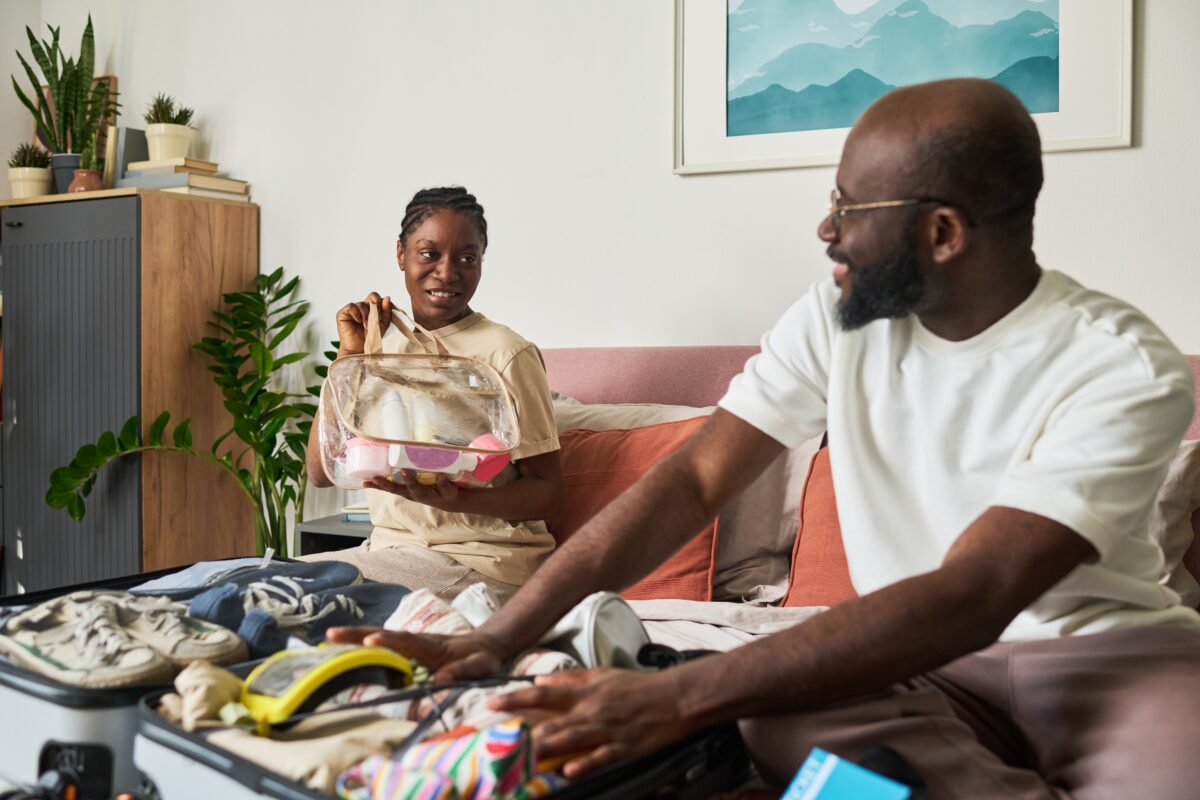
As mentioned, your cabin has basic toiletries, but probably not at the quality you like. So pack your own favorites. These are items the whole family can share, which keeps the total down:
- Sunscreen
- Insect repellent
- Travel-size lotion
- Sanitary products
- Favorite medications
- Travel-size hand sanitizer
- Small laundry soap (if you’d rather not use the onboard service)
- Wrinkle-release spray
- Preferred shower gel, shampoo, and conditioner
- Shower cap
- Shaving items
- Toothbrushes and toothpaste
- Non-perishable snacks for travel days and shore excursions
You can buy these in the onboard shops too, but expect high prices and the real chance they’ve run out of your item. (I was once on a sailing that had run out of every kind of ibuprofen by the second day, right before two back-to-back sea days.)
Pack a small first aid kit
Bring a small first aid kit, or at least a pack of band-aids. We end up needing at least one almost every trip, whether it’s a scraped knee, a cut hand from a cooking-class excursion, or a scratch on a rocky beach.
The savings matter, but that’s not the main reason. Having your own supplies means you avoid a trip to the ship’s medical center, which may keep odd hours or have a wait. For a minor scrape, you want the band-aid in your bag, not a visit to the clinic.
Don’t skimp on hand sanitizer
You can never have too much hand sanitizer on a cruise. Ships work hard to control the spread of stomach bugs, and your hands are the front line. I bring several small travel bottles and stash one in each bag: a purse, the carry-on, and the family day bag. If you don’t like liquid, sanitizing wipes work too, and they pull double duty for wiping down tray tables and armrests.
Important note on reef-safe sunscreen
This one is new since the old version of this article, and it’s worth keeping in mind. A growing number of destinations now restrict the kind of sunscreen you can wear in the water.
- In Mexico’s Quintana Roo region, which includes popular cruise stops like Cozumel along with Cancun, Playa del Carmen, and the cenotes, you’re required to use biodegradable, reef-safe sunscreen. At many cenotes and marine parks, including spots around Cozumel, you may be asked to use no sunscreen at all and rinse off before entering the water.
- In Hawaii, sunscreens with oxybenzone and octinoxate are banned, and some counties (including Maui and the Big Island) go further and allow only mineral sunscreens.
The simplest move is to pack a mineral, reef-safe sunscreen as your default and check the rules for your specific ports. It saves you from having a chemical sunscreen confiscated or being turned away from a swim spot.
For more low-cost items that punch above their weight, see our list of useful things to bring on a cruise for under $20.
Electronics, Charging, and “Ship Time” Gear
Charging is where families get tripped up, because cabins are short on outlets. Many staterooms have just one set of power outlets outside the bathroom. Now count how many things your family carries that need power, and multiply by the number of people in the cabin. The math gets ugly fast.
Here’s the part you have to get right, because the rules have tightened: surge protectors are banned on every major cruise line. A ship’s electrical system isn’t wired like your house, and a surge protector can overheat and become a genuine fire hazard. Beyond that, the rules vary by line. Royal Caribbean now prohibits all power strips and extension cords entirely, even non-surge ones, and asks you to rely on USB charging blocks or the cabin outlets. Carnival and Norwegian still allow plain, non-surge power strips, but not surge protectors.
So what should you actually pack? A small, palm-size USB outlet expander, the kind with multiple USB slots and no surge protection. If most of your devices charge by USB, this is the safe, allowed, space-efficient answer across lines. (When in doubt, check your specific line’s current policy before you sail, since these rules change.) We explain the safety issue in why surge protectors are banned on cruise ships, and our pick is covered in this must-have cruise accessory.
A few more electronics worth packing:
- A power bank for port days, especially long bus or van rides, and for topping off phones and cameras. One good one is plenty, as long as you remember to recharge it. Buy it at home. I once watched a ship sell power banks cheaply with a strict no-return policy, and some turned out to be defective, which we only discovered ashore when we needed them. Thankfully we’d brought our own too.
- Tablets, fully loaded with downloaded shows, movies, and games. A tablet is your best friend for cabin downtime, long transfers, and waits. Cheap models work fine, and ideally everyone has their own.
- Extra headphones and charging cables, plus extra batteries for anything important.
A watch that stays on “ship time”
This is a safety item disguised as a gadget. When you’re in port, you need a reliable way to keep time that won’t auto-update to local time. Many ports do not match the ship’s clock, and the all-aboard time is always posted in ship time. Bring an inexpensive watch or another manually set timepiece, and confirm it’s on ship time before you leave the ship.
Worth doing for kids too: any child who signs themselves out of the kids club or is allowed to move around the ship independently should have a watch so they know exactly when to meet you.
Cabin Setup: Small Items That Make the Room Livable
A few small items make a tight cabin work much harder. Most cabin walls are steel, which opens up some clever storage:
- Magnetic clips and hooks (clip or clamp style). They stick right to the walls and hold schedules, hats, wet swim items, and more.
- An over-the-door shoe organizer for the bathroom door, perfect for corralling toiletries and small items off the counter.
- A hanging closet organizer to add shelves to limited closet space.
- Lanyards with ID card holders for everyone’s room cards. You can buy these on board, but not cheaply.
- A laundry bag to keep dirty clothes contained.
For more ideas on making the space comfortable, see our guide to making your cruise ship room cozy.
The Family Port-Day Bag
This is the section that earns the “port days” in the title, and it’s one of the highest-value habits we’ve built over the years.
Different family members may carry their own small items, but you want one primary bag that holds the family essentials. It doesn’t mean one person hauls it all day. It can be a shared responsibility. The point is that having a single consolidated bag means you can confirm in one spot that you’ve got everything you need, which cuts way down on leaving key items behind. Bonus: you can pack most of it the night before and get out the door faster, so you get more of your day in port.
The type of bag doesn’t matter much, as long as it fits everything. For a beach day, a big tote works well. For a city day, a backpack is easier to carry. Hybrids of the two are great.
What goes in the family day bag:
- Water, and plenty of it. On hot, walking-heavy port days, you’ll go through more than you expect.
- Snacks, especially for ports where you can’t easily duck into a store.
- Reef-safe sunscreen and hand sanitizer.
- A small pack of tissues. Some port restrooms run out of toilet paper, and tissues have saved the day more than once.
- A small amount of local or U.S. cash.
- Your ship-time watch and the power bank.
- Copies of IDs and any important medical info.
- Any medications your kids might need during the day.
And the rule that ties it all together: know your all-aboard time, keep everything on ship time, and plan to be back at the port well before the posted time. The farther your excursion takes you, the more buffer you want. For more, see our top cruise excursion tips and our list of useful items for family port calls.
Packing by Age and Stage
What you pack shifts a lot depending on how old your kids are. Here’s how I think about it in tiers.
Babies and toddlers
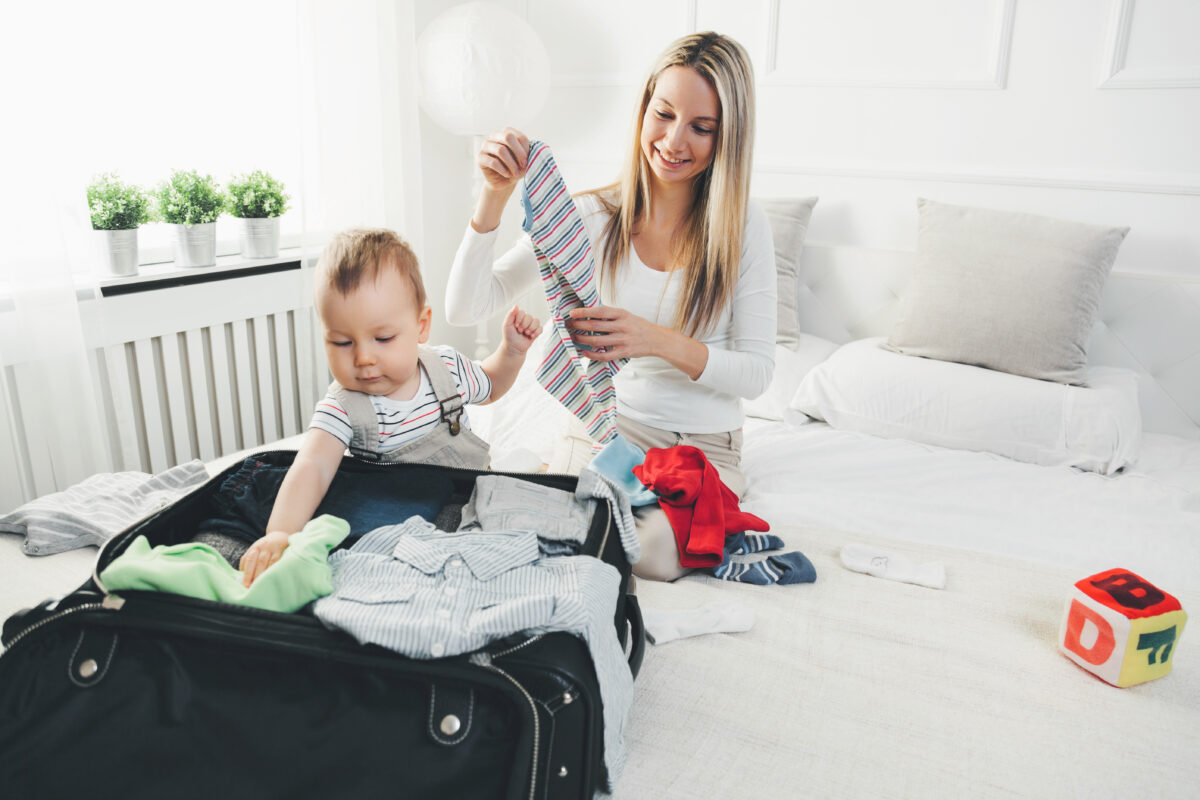
This is where you have to be the most detail-oriented. Pack carefully, and do not assume you can buy or replace things easily. Make a list of the items you’d genuinely struggle without for 3 days: diapers, wipes, formula, preferred pain reliever, and sanitary products. Many of these aren’t carried on board, or they run out fast. And you can’t count on finding your exact product in port. You might only find an unbranded children’s medicine with all the instructions in a language you don’t read.
A few specifics that matter:
- Stroller. A lightweight umbrella stroller is a real asset for the ship, airports, and ports, and it doubles as a shady nap spot at the beach. Skip the large, deluxe stroller. It eats cabin space and may not even fit through your cabin door while open. Worth knowing on availability: Disney offers complimentary strollers on board on a first-come basis through Guest Services, and Carnival rents single strollers (subject to availability) for around a $75 deposit. Most other lines don’t provide them, so plan to bring your own.
- Bottle cleaning kit. Pack a small bottle of dish soap and a bottle brush. The ship’s bathroom soap won’t do the job well and can leave an aftertaste. A portable sanitizer isn’t strictly necessary, since the bathroom tap usually gets hot enough, but some parents like the peace of mind.
- A favorite lovey, book, or bedtime item. Familiar comfort items make the new environment easier at night.
Before you sail, check what your specific ship can provide (cribs, high chairs, diaper disposal, even baby food), since that can trim your packing. We cover this in detail in our post on essential baby items for a cruise and our cruising with a baby resource page.
Big kids and tweens
This age is easier, and it’s a great time to give them some ownership. Let them help pack their own small day bag with the essentials: a water bottle, a hat, their water shoes, and a device with headphones for downtime and transfers. Water sandals they’ll actually keep on are worth their weight in gold here. Make sure they’re set for the kids club too, which usually just means comfortable clothes they can play in.
Teens
Teens mostly need independence gear. A watch or phone for keeping meeting times is the big one, since they’ll likely roam the ship and sign themselves in and out of the teen spaces. Pack at least one dressier outfit so they can join a dress-up night if they want, and let them bring what they’ll actually want for lounging in the teen lounge and at the pool.
A note on privacy: keep names and identifying details off luggage tags and out of view, and make sure kids know not to share their cabin number with people they meet on board.
What to Leave Home
The fastest way to stop overpacking is to know what not to bring. Leave these behind:
- Bulky beach towels. The ship provides them.
- A hair dryer, in most cases. There’s one in the cabin.
- Full-size toiletries. Go travel-size and share across the family.
- Irons and garment steamers. These are banned on every major line as a fire hazard and will be confiscated at security, then returned at the end of your cruise. Use the ship’s self-service launderette irons or valet pressing instead, and pack a wrinkle-release spray for quick touch-ups. (More on this in our post on why irons are banned on cruise ships.)
- Surge protectors and, on some lines, any power strip. See the electronics section above.
- Snorkel fins, unless you’re serious about snorkeling. Too bulky.
- More than one formal outfit per person. One dressier set covers the 2 nights.
- A large, deluxe stroller. It won’t fit the cabin well.
- Too many shoes. Three pairs per person usually does it.
The Bottom Line
So, what’s the bottom line on family cruise packing? Keep the system simple and let it carry the load:
- Pack by category, then by person, and remember that space, not weight, is your real limit.
- Plan your laundry before you pack, so you can bring less.
- Build a family port-day bag and prep it the night before.
Get those three right and the rest is just filling in the details. Grab our free Family Cruise Prep and Pack Checklist to pack from, tick-box by tick-box, including a pre-cruise prep list for documents, reservations, and check-in.
And if you want the full playbook for planning a cruise with kids, my book The Family Cruise Companion’s Guide to Cruising With Kids goes deep on everything from choosing a cabin to surviving port days. Happy packing, and even happier sailing.

Elaine Warren
Founder & Crew Chief
Elaine founded this website after publishing the book The Family Cruise Companion’s Guide to Cruising With Kids. (Second edition recently released!) She has sailed on 50 cruises (and counting). She loves helping families navigate their way to an adventure-filled, fun, and memorable vacation.